
Blog #3
The Calm Before the Storm
It’s the final lead-up to the Paralympic Games, and we’ve just wrapped up our staging camp in Obertilliach, Austria. As I write this, I’m sitting on a bus with the Para Nordic team, making our way to the Paralympic Village — and it’s hard not to feel the magnitude of what’s ahead.
As you may have seen during the Olympics, the villages and competition venues are spread out across Italy. Our home for the Games will be in Predazzo, and we’ll compete at the Tesero Nordic Centre — the very same venue where Olympic cross-country champions were crowned. In just a few short days, the world’s best Para athletes will step onto that stage and compete over 10 unforgettable days, each of us carrying the hopes of our countries and the stories that brought us here.
As we inch closer to the Opening Ceremony on March 6, a wave of emotions settles in — excitement, gratitude, nerves, anticipation. It’s one of the most exhilarating and vulnerable spaces to sit in as an athlete. And it’s exactly why I value the intention behind a staging camp before the Games begin.
A staging camp serves three important purposes. It gives us the chance to:
1. Adjust to the time zone and shake off jet lag.
2. Execute our final key training sessions with focus and purpose.
3. Embrace a calm, quiet environment before stepping into the energy and intensity of Village life.
Some of our key sessions included:
● An over-distance ski (2+ hours of steady skiing)
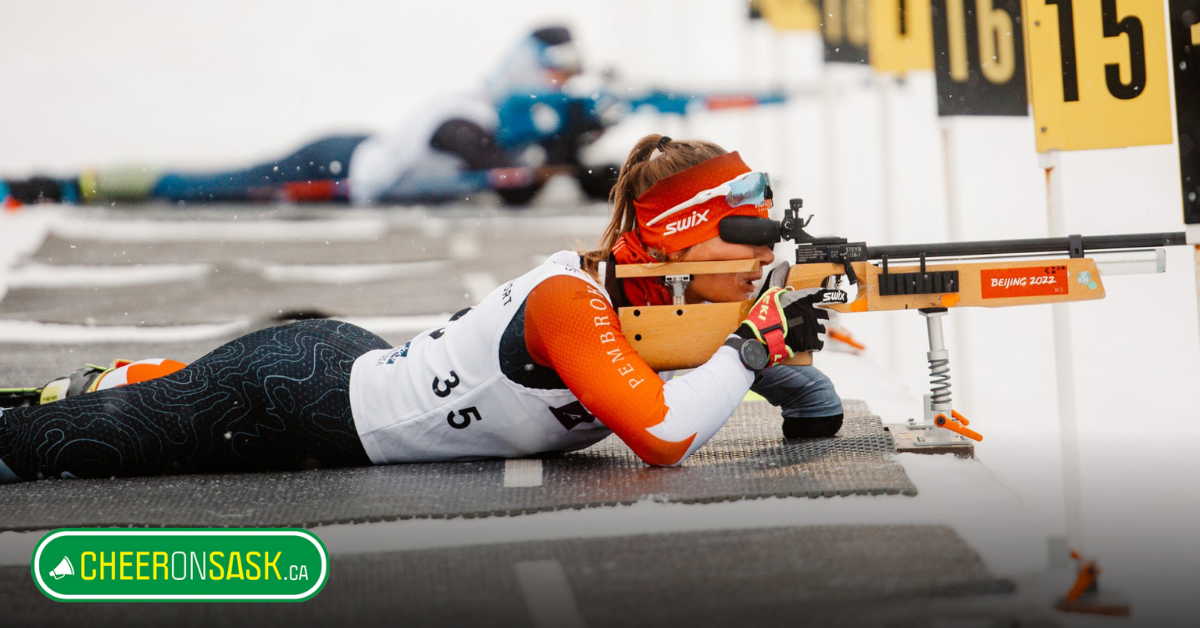
● Four focused shooting sessions
● An interval workout of two sets of 4 x 45 seconds at max effort
● A 7.5-kilometre team time trial
Our eight days in camp struck the perfect balance — locking in our preparation and building quiet confidence, while also allowing space to breathe, reset and mentally prepare for what’s to come.
Over the nine days of competition, I’ll compete in five individual events: three biathlon races on March 7, 8, and 13, and two cross-country races on March 11 and 15. Each start line represents years of preparation, resilience, and belief.
All competitions will be broadcast on CBC Gem and I would truly love your support. Knowing people are tuning in, cheeringand sharing in this journey means more than I can fully express.
Thank you to everyone who has followed along with this blog series. We’re at a pivotal moment in the growth of the Paralympic movement where awareness is rising, stories are being told and barriers continue to be challenged. I encourage you to listen, learn and witness the magic of the 2026 Milano Cortina Games.
Ciao 🇮🇹
Brittany
Find the specific Paralympic schedules and results for Saskatchewan athlete, including Brittany, on our Cheer on Sask website. You can also follow along the entire Paralympic schedule here.
Blog #2
You spend years preparing for an event that takes place once every four years. That is the reality of what it feels like to qualify and train for a Paralympic year. A very exciting but slightly anxiety causing time. You can’t help but hope everything goes according to plan, yet it rarely does. More on that later.
This past month of November was centred around key training sessions to prepare for the upcoming competition season and qualifying races. In endurance sport, this means the majority of the work has been done, and now the focus hones in on fine tuning fitness and speed. Many Canadian skiers made their way to Canmore, Alberta in order to prep for the first races of the season. At the end of November, the Canmore Nordic Centre hosted a Continental Cup; giving athletes a crack at early season racing. More importantly, it provided an opportunity for athletes to gain race experience and a shot at earning FIS points. If athletes haven’t raced internationally before, this means they can earn themselves a start at a World Cup. Let me give a breakdown of how athletes qualify to race at a World Cup and earn a spot for the Paralympic Games.
A points ranking system known as FIS points, is utilized to understand the time gap behind an athlete and the winner. These FIS points are calculated based off of an athlete’s race results. In short, the athlete must meet a minimum amount of FIS points in order to be eligible to start a World Cup. From there, athletes need to race a World Cup and gain FIS points in order to potentially earn a spot on the team for the Games. This Paralympic year, our team has 12 spots split equally for men and women. Those who race the World Cup will be ranked from their results and the top Canadian athletes will earn a spot on the team for the Paralympics.
Going back to things not going accordingly to plan, at the end of November I woke up with a stuffy nose and knew a cold was coming on. This meant that I wouldn’t be able to start the Continental Cup race and instead, I stood on the sidelines and cheered for my teammates. After this I set my sights on getting healthy in order to be ready to race the first World Cup where I would need to earn my spot on the Paralympic team.
December marked the start of our World Cup season where we kicked things off competing in Canmore, Alberta from December 4-14. On our circuit we are able to complete in both cross-country and biathlon races. During this World Cup we had a total of six race opportunities over the 10-day period. My individual plan was to compete in one cross-country race and all three biathlon races. Having experienced a knee injury back in June 2024, my plan was slightly more conservative than others with a focus on keeping my knee healthy. I started off competing in the 10-kilometre classic race where I surprised myself with a fourth-place finish! Next up, I took the start line for the 7.5-km biathlon race and came away with a bronze medal! I got to share the podium with one of my teammates which always feels extra special. The last two races we had a significant temperature change and it brought in heavy wind gusts, making it challenging to hit targets on the range. Unfortunately, I didn’t manage to have a good shooting day and found myself finishing sixth.
Overall, it was a great start to the season but I will be aiming to build from these first races. The race season is long, and our team has prioritized having our best performances for the big show in Italy 2026. This first World Cup has provided a snapshot of my current fitness and while there is always things I’d like to improve, I’m satisfied with my progress thus far. Although our team is not confirmed yet, the results show it is highly likely I have stamped my ticket to the Paralympics. Thanks for reading and stay tuned for the official announcement of our team and another update on the next set of World Cup races!
Blog #1
Hello and welcome to the Saskatchewan athlete blog series! My name is Brittany Hudak and I’m here to share an inside perspective of my journey leading into the Milano Cortina 2026 Paralympics where I hope to be competing in Nordic Skiing and Biathlon!
First things first, why would I choose Nordic Skiing in a province that is known for relentlessly cold winters? Well, even though the wind blows in Saskatchewan, the people are what make this province truly special. Turns out that being a part of an uplifting environment had a huge impact on my motivation to pursue a new sport.
I have been competing internationally for Canada since 2014 and was born and raised in Prince Albert. I was born missing part of my left arm below the elbow and had never heard about the Paralympics until I was 18. You might find it comical that my sport career started at the local Canadian Tire. That’s right, I was in my first year of university working in the hardware department at Canadian Tire when legendary ten-time Paralympian and medallist Colette Bourgonje wheeled up to me and asked if I wanted to try Nordic Skiing. At the time, I recalled skiing on two occasions — one being in the field behind my elementary school. Colette briefly informed me about the Paralympics and how it allows for athletes with varying disabilities to compete on a level playing field. She left me with her contact info and my gut instinct was to reach out.
Something about the sport initially got me hooked — maybe it was the challenge or the idea of exploring new trails. Those that know Saskatchewan can understand that feeling of the cold winds biting against your face when you go outside in the peak of winter. What I quickly learned was that challenges can bring people together.
Starting my ski career in Saskatchewan skyrocketed my success in a few ways. I was fortunate to receive support from Sask Sport and the Canadian Sport Centre Saskatchewan through funding from Sask Lotteries. This paired with the support of a local ski club and connections made through Colette, enabled me to fast track my development in the sport. And by fast track I mean I ended up qualifying for the 2014 Paralympics in Sochi just two years after picking it up! I have zero doubt that this would not have been possible if it wasn’t for the unwavering support I received in Saskatchewan.
Following my Paralympic debut in 2014, I went on to make the Canadian National Team in 2015 and spent the winter racing my first year on the World Cup Circuit. Once I had a couple years learning how to ski, I decided to make things difficult for myself again, so I picked up a rifle and tested my luck in biathlon. For those that don’t know, biathlon is the combination of Nordic skiing and shooting. In short, we ski a lap and come in with a racing heart rate and try to hit targets the size of a dime at a distance of ten metres. If we happen to miss a target, we ski a penalty loop of 150-m for each missed shot. The long-distance biathlon race penalizes us even more for a missed shot with a one-minute time penalty.
Sounds fun right?! Combining two vastly different sports that require a high calibre of physical and mental energy felt like the ultimate challenge and led to my love for biathlon. It also led to my first Paralympic medal and several podium performances at international competitions. By competing in both sports, it means that I have the option to race in six individual races at World Cups and Paralympics. More chances for medals yes, but oh so many hours spent training to master the difficulties of the sport.
Looking back to the lead up into the 2022 Beijing Paralympics, I really felt confident in where I had taken my training during that quad. I was consistently landing on the podium in both skiing and biathlon races, and my body was handling the yearly training hours that range from 650-750 depending on the year. With the Covid-19 pandemic, it was a milestone just getting to the Games. In Beijing, I managed to earn two bronze medals — one more medal than my previous Games in 2018 where I won bronze. Now we are less than five months out from the 2026 Milano Cortina Games in Italy and I am so excited for the experience.
Our team went on two training camps this year that led us to New Zealand and Mammoth Lakes, California. Both camps are frequent spots that we travel to for different training purposes. Each year we head to New Zealand in August for three weeks where we prioritize long training hours with a technical ski focus on snow. Even though it’s a long haul to travel to New Zealand, we find huge benefit in an opportunity to refine ski technique on snow (Nordic Skiers love to chase winter!). Mammoth Lakes is our fall camp and involves high altitude training that helps to boost our red blood cell production and aerobic capacity. This is one of my favourite camps because it’s situated amongst the Sierra Nevada mountain range and boasts beautiful views with amazing terrain for training. As part of my summer cross training, I LOVE trail running and there is no shortage of trails in Mammoth.
Following this training camp, we will have a one-week recovery period and then start an intensity block. Our intensity blocks consist of short, hard interval efforts such as six-by-three minutes max effort. This helps us to maximize the training we did at altitude and preps our bodies for race season. October for Nordic skiers is the transition phase where our training includes more interval sessions in order to start increasing speed and power for the race season. It’s all part of the road to Milano Cortina 2026 and I hope you find the journey as exciting as I do!